Maintenance and development of competence among nurse anaesthetists – a national cross-sectional study
Summary
Background: Nurse anaesthetists are expected to maintain the same professional standards regardless of workplace, available resources or patient volume. Few studies have examined how nurse anaesthetists maintain and develop competence at a national level.
Objective: The objective of the study was to gain insight into the methods nurse anaesthetists use to maintain and develop competence, as well as the perceived usefulness of these methods. We also sought to explore whether routines and practices vary according to department size and geographic location. In addition, we examined awareness of and participation in the competency programme of the Norwegian Association of Nurse Anaesthetists, a member of the Norwegian Nurses Organisation, and whether a national, standardised competency programme is considered desirable.
Method: We conducted a quantitative cross-sectional study using a questionnaire distributed via Nettskjema.no. Potential participants were invited to participate via an email sent to clinical nurse educators, who forwarded the survey to nurse anaesthetists. Data were analysed in SPSS using descriptive statistics, Pearson’s chi-squared test and Fisher’s exact test.
Results: A total of 254 (14.5%) of Norway’s 1750 nurse anaesthetists responded to the questionnaire, representing a good distribution in terms of age, years of experience and department size. All regional health authorities were represented, although few participants were from Western Norway Regional Health Authority (n = 16). Nurse anaesthetists, regardless of years of experience, department size or geographic location, reported increased clinical confidence as a result of simulation training and various competence development methods. Western Norway Regional Health Authority and South-Eastern Norway Regional Health Authority allocated the most time to competence development. Overall, 59.1% (n = 150) of participants reported that insufficient time is allocated to competence development; over 50% had not attended external courses in the past year; 6.3–18.5% had not participated in simulation training; and 10.4–32.7% had not attended a professional development seminar. In total, 74.4% (n = 189) expressed a desire for a national, standardised competency programme.
Conclusion: Many nurse anaesthetists throughout Norway reported having no access to internal or external courses, simulation training or professional development seminars, and expressed a need for more opportunities to maintain and develop competence. They considered the current approach to be insufficiently structured and called for a national competency programme for nurse anaesthetists.
Cite the article
Skarpås M, Baardsen I, Skarsaune K, Gustad L. Maintenance and development of competence among nurse anaesthetists – a national cross-sectional study. Sykepleien Forskning. 2026;21(105897):e-105897. DOI: 10.4220/Sykepleienf.2026.105897en
Introduction
In Norway, nurse anaesthetists are expected to maintain a high level of competence and patient safety in the field of anaesthesia (1). A 40-year study of nurse anaesthetists in Norway indicates that professional autonomy has gradually declined, particularly in larger hospitals with a higher density of anaesthetists. Meanwhile, autonomy in certain emergency settings has increased. The study calls for closer examination of the division of responsibilities between nurse anaesthetists and anaesthetists, and highlights the importance of sufficient training in practical skills (2).
The International Federation of Nurse Anaesthetists (IFNA) anticipates that advances in technology and science will further expand the scope of practice of nurse anaesthetists, and lifelong learning is therefore considered a core international requirement (3).
Nurse anaesthetists are advanced practitioners with a broad scope of responsibility that requires training. Clinical practice is one such area (3). In this domain, nurse anaesthetists have advanced and often autonomous responsibilities for patient assessment, administration of anaesthesia and patient monitoring, as well as preparedness for acute events throughout the perioperative period (4–6).
Several studies suggest that continuing professional development (CPD) of clinical skills following qualification is essential to attaining, maintaining and improving professional competence, thereby ensuring patient safety and professional standards of practice (3, 7–9).
The IFNA defines CPD as consisting of internal educational activities, such as courses, lectures, workshops and simulation training, and external activities, including courses and conferences (3). Simulation training can enhance nurse anaesthetists’ clinical confidence and competence in rare but critical situations by providing training in a risk-free environment (7–10).
Effective competence development requires facilitation of structured learning environments by management (11). National policy documents identify systematically structured competence maintenance and lifelong learning as guiding principles (12–14).
The competency programme of the Norwegian Association of Nurse Anaesthetists (NANA), a member of the Norwegian Nurses Organisation (NNO), facilitates systematically structured and continuous competence development through mandatory learning activities in clinical anaesthesia, airway management, emergency medicine and simulation training. Over a five-year period, 100 hours of learning activities are required, comprising 80 mandatory hours and 20 hours that can be tailored to local conditions (15).
An older report from the Norwegian specialist health service indicates considerable variation in investment in competence development across regions (16). A more recent internal audit shows ongoing variation in the prioritisation and structuring of competence development, even between departments within the same hospital (17). Production pressures and insufficient prioritisation of professional development can also hinder the maintenance and development of competence (18).
Practices vary considerably despite the recommendations for regular updating and skills training in the Norwegian standard for the safe practice of anaesthesia and NANA’s foundational documents. Norway does not have a standardised re-certification system such as the Continued Professional Certification (CPC) programme in the United States (5, 15, 19).
The evidence base is still limited in relation to which competence development methods, other than simulation training, nurse anaesthetists use throughout Norway, and it remains unclear whether use of such methods varies between regional health authorities and departments of different sizes. Awareness of and participation in NANA’s competency programme is also unknown, as is whether nurse anaesthetists would support a national standardised programme.
Objective of the study
The objective of the study was to investigate which learning activities nurse anaesthetists use to maintain and develop their competence. We also sought to determine the perceived usefulness of these activities, and whether practice differs depending on geographic location or organisational setting. Finally, we aimed to assess participants’ awareness of, and need for, a national competency programme.
Research questions:
- What methods do nurse anaesthetists use to maintain and develop competence? Do they consider them useful?
- Do nurse anaesthetists, regardless of years of experience, find that maintaining and developing competence helps enhance their clinical confidence?
- Is there an association between geographic location or department size and the structure of competence maintenance and development, including the allocation of time and resources?
- Are nurse anaesthetists aware of NANA’s competency programme for nurse anaesthetists, and is it applied in clinical practice?
Method
Design
This is a quantitative cross-sectional study in which a questionnaire was distributed to nurse anaesthetists regardless of age, years of experience or department size. Participants were recruited via an email sent to the professional development nurse or head nurse anaesthetist at the workplace of potential participants.
The clinical nurse educator forwarded the questionnaire to nurse anaesthetists in their department. The STROBE checklist for observational studies was used.
Setting
This national study included nurse anaesthetists from all of Norway’s regional health authorities: South-Eastern Norway Regional Health Authority, Western Norway Regional Health Authority, Central Norway Regional Health Authority and Northern Norway Regional Health Authority. No restrictions were placed on type of department, and participants could therefore be from day surgery units or in-patient surgical departments. According to Statistics Norway, there are an estimated 1750 nurse anaesthetists in Norway (20).
Questionnaire
A bespoke questionnaire was developed for this study (Appendix 1 – in Norwegian), as no suitable instrument was identified that captured CPD activities for nurse anaesthetist competence.
A literature search was conducted in PubMed, Google Scholar and Oria using variations of the following search terms: nurse anaesthetist, certified registered nurse anaesthetist (CRNA), anaesthetist, standards of practice, competence, competencies, patient safety, quality, professional expertise, professional development, education, training, core competency, standard, continued competence, recertification.
The questionnaire was developed in collaboration with supervisors and in line with the literature on questionnaire design (21), and was distributed via the online survey tool Nettskjema.no to ensure secure data collection.
Three nurse anaesthetists pilot-tested the questionnaire to identify potential ambiguities. This resulted in minor revisions, including clarification of certain terms and the addition of a question on geographic location. The average completion time was four minutes, indicating that the questionnaire was time efficient.
The terms competence maintenance and competence development are used in the questionnaire, which are related but separate concepts. The former refers to the retention of existing knowledge and skills through repetition and updating to ensure safe and competent practice. The latter refers to an active learning process aimed at acquiring new knowledge or skills to manage more advanced tasks or meet new requirements (22).
A learning activity may be regarded as competence maintenance by an experienced nurse but as competence development by a less experienced nurse. We therefore used both terms.
The questionnaire comprised 35 items in total. Five demographic questions collected information on respondents: 1) age categories (25–35 years, 36–45 years, 46–65 years), 2) current full-time equivalent (FTE) percentage (< 50%, 50–70%, > 70%), 3) years of experience (0–5 years, 6–10 years, > 10 years), and 4) number of nurse anaesthetists in the department. This number was used to define department size (1–10 nurse anaesthetists = small department, 11–20 = small to medium-sized department, 21–30 = medium-sized department, > 30 = large department), and (5) the regional health authority in which they were employed (South-Eastern Norway Regional Health Authority, Western Norway Regional Health Authority, Central Norway Regional Health Authority, Northern Norway Regional Health Authority).
Thirteen questions assessed learning activities aimed at developing and maintaining competence. Six questions addressed how often (0 times, 1–3 times, 4–10 times, > 10 times) participants had attended (1) internal courses, (2) external courses, (3) simulation training, (4) professional development seminars, (5) e-learning, or (6) internal teaching sessions. The seventh question related to the topics participants had covered during simulation training in the past year, and had ten response options.
Questions 8–13 addressed the perceived usefulness of different learning activities: (8) internal courses, (9) external courses, (10) simulation training, (11) professional development seminars, (12) e-learning and (13) internal teaching sessions, with response categories of not useful at all, useful to a limited extent, moderately useful, and very useful.
One question on whether learning activities help improve nurse anaesthetists’ clinical confidence had the response options disagree, neither agree nor disagree and agree.
Nine questions addressed the structure of learning activities and the allocation of time and resources. Time allocated to learning activities was categorised as either protected time or random. The question on whether respondents felt they had sufficient time and resources had the response options disagree, neither agree nor disagree and agree.
Six questions on time allocated to learning activities assessed how often, over the past year, nurse anaesthetists had participated in internal courses, external courses, simulation training, professional development seminars, e-learning or internal teaching sessions, with response options of 0 times, 1–3 times, 4–10 times and > 10 times. The ninth question assessed who was responsible for learning activities, with response options of myself, departmental management and shared responsibility between myself and management.
Three questions assessed (1) the need for a national competency programme for nurse anaesthetists, (2) awareness of the NANA’s competency programme and (3) participation in NANA’s competency programme. The first was answered using the response options disagree, neither agree nor disagree and agree, while the latter two had response options of yes and no.
Data collection
Data were collected over a two-month period, from 17 March to 17 May 2024. Two reminder emails were sent to all departments, and follow-up was conducted via telephone with five selected departments. Three of the five randomly selected departments reported that they had not received the questionnaire. This may have been due to incorrect internal email addresses or key personnel’s failure to forward the survey.
Statistics
The data collected were coded in Nettskjema and then exported as a .txt file to SPSS version 29 (IBM). Data accuracy was ensured by verifying concordance for 10% of the variables between SPSS and Nettskjema, including data format, missing data and any changes to variable names.
Descriptive statistics, presented as absolute numbers (n) and percentages (%), were used to describe the sample by age, years of experience, FTE percentage and department size for each regional health authority. Pearson’s chi-squared test was used to assess whether these variables were equally represented across the regional health authorities.
Descriptive statistics were also used to show the number (n) and percentage (%) of nurse anaesthetists who reported the six learning activities as not useful at all, useful to a limited extent, moderately useful and very useful.
Cross-tabulations were used to examine whether geographic location or department size was associated with the time and resources allocated to learning activities, as well as participants’ awareness of NANA’s competency programme.
Pearson’s chi-squared test was used to assess associations in cross-tabulations where there were more than five observations in each category. Fisher’s exact test was used where there were fewer than five observations in any category. Statistical significance was set at p < 0.05 for all analyses, which were conducted using SPSS version 29. Cronbach’s alpha was not calculated, as the questionnaire measures multiple constructs and does not meet the criterion for unidimensionality (23).
Ethical considerations
Prior to the study, an assessment was obtained from Sikt – Norwegian Agency for Shared Services in Education and Research (reference number 947626). Participation in the study was voluntary. Alongside the questionnaire, respondents were provided with information about anonymity and the aim and background of the project. Completion of the questionnaire was considered to constitute informed consent to participate.
Results
Following the initial distribution of the questionnaire, 122 responses were received within one month. The first reminder yielded an additional 70 responses, and after the second reminder and telephone follow-up, a further 62 responses were received. In total, 254 nurse anaesthetists completed the questionnaire, corresponding to 14.5% of the estimated 1750 nurse anaesthetists in Norway (20).
Participant characteristics
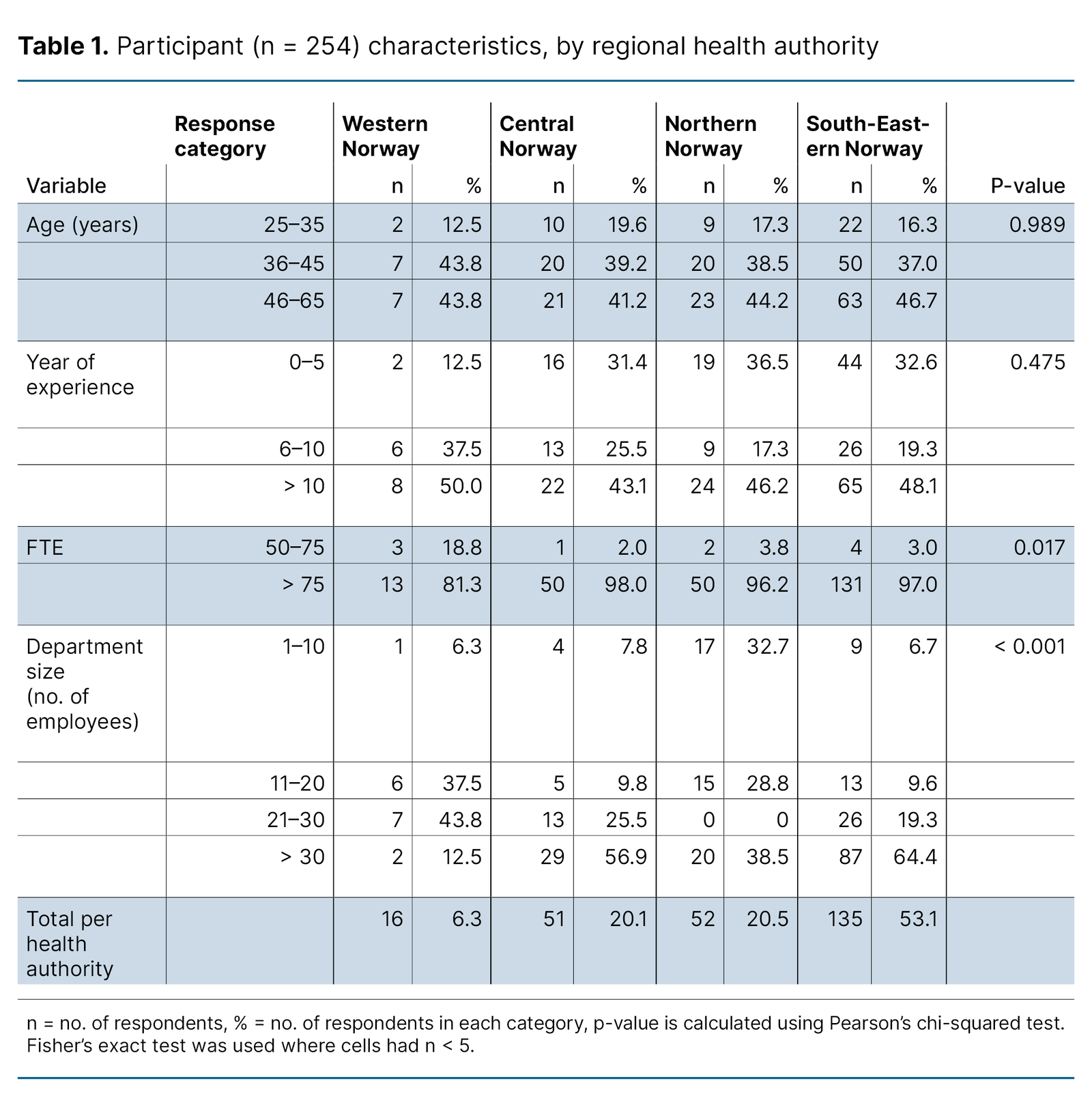
The smallest proportion of respondents was from Western Norway Regional Health Authority (n = 16; 6.3%), while 135 (53.1%) were from South-Eastern Norway Regional Health Authority. No respondents worked less than 50% of an FTE. The majority of respondents (96%, n = 244) worked 75% or more, and Western Norway Regional Health Authority had the highest proportion working 50–75% (p = 0.017). Age and years of experience were evenly distributed across the regional health authorities (p = 0.989), and most respondents had more than five years of experience (68%, n = 173).
A total of 12.2% (n = 31) worked in a small department, 33.5% (n = 85) in a medium-sized department and 54.3% (n = 138) in a large department. Nurse anaesthetists in South-Eastern Norway Regional Health Authority were more likely to work in larger departments (p < 0.001) (Table 1).
Nurse anaesthetists’ competence
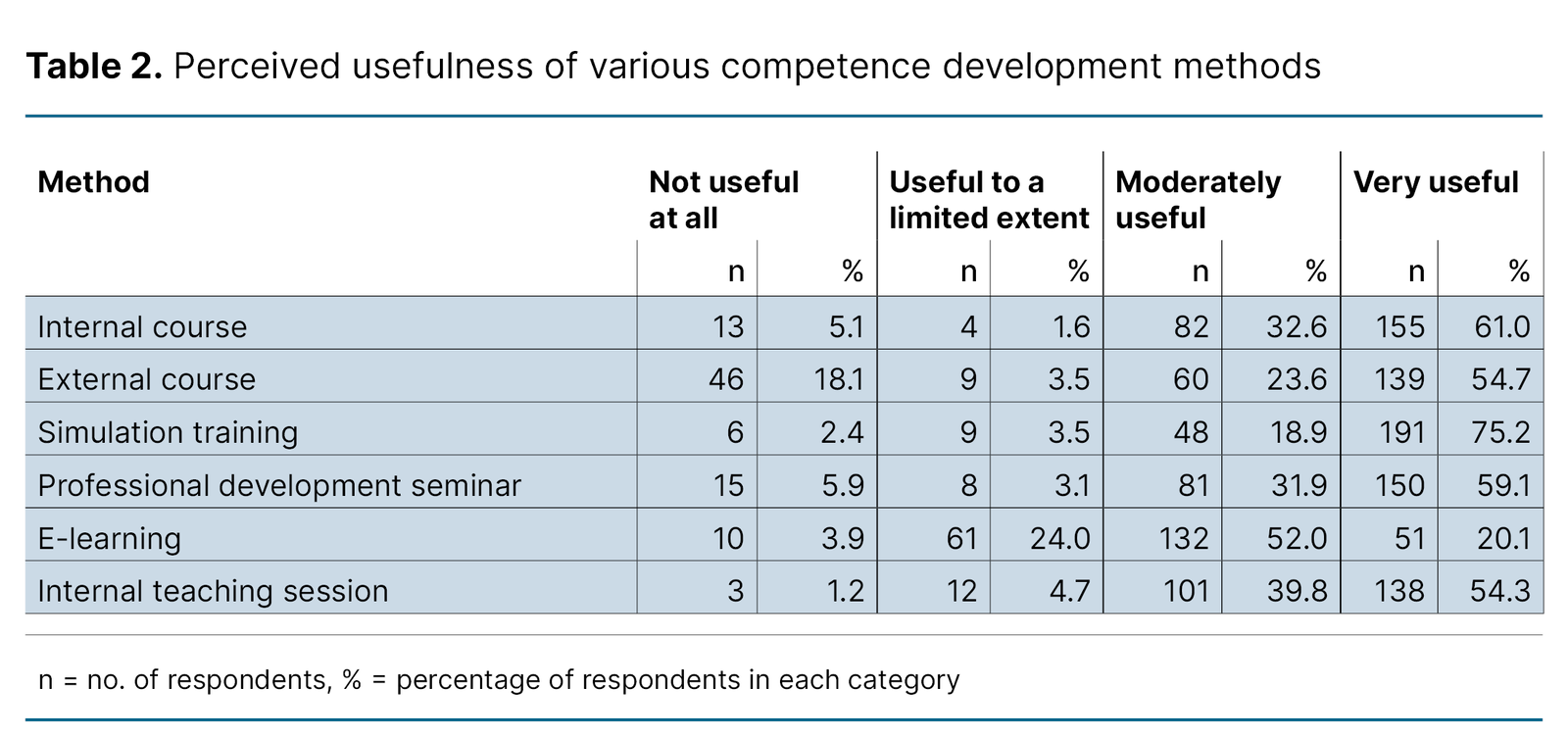
More than 70% of respondents reported that all the listed learning activities were moderately useful or very useful. Most perceived simulation training as very useful (75.2%, n = 191). A total of 21.6% (n = 55) considered external courses to be useful, while 27.9% (n = 71) reported that e-learning was of no use at all or useful to a limited extent (Table 2).
When asked whether learning activities help improve nurse anaesthetists’ clinical confidence, there was broad agreement across the categories of years of experience (0–5 years, 6–10 years, and > 10 years), with 98% (n = 249) stating that these activities help improve their clinical confidence.
Forty-eight per cent (n = 122) reported having protected time for learning activities, while 52% (n = 132) stated that the time allocated was random. The highest proportion was found in South-Eastern Norway Regional Health Authority (57.8% of 135 respondents), where protected time was allocated for learning activities. The corresponding figures were 56.3% of 15 respondents in Western Norway, 42.3% of 52 respondents in Northern Norway and, with the lowest proportion, 25.5% of 51 respondents in Central Norway (p < 0.01).
A total of 59.1% (n = 150) of participants felt that insufficient time and resources were allocated to learning activities in their department. Only a small proportion (n = 25, 16.6%) agreed that sufficient time and resources were allocated, while the remainder gave a neutral response to this question. No major differences were found between the regional health authorities (p = 0.09).
More than 50% of nurse anaesthetists had no access to external courses in the past year; between 6.3% and 18.5% had not participated in simulation training, and between 10.4% and 32.7% had not attended a professional development seminar (Figure 1). Access was the same across the regional health authorities for internal courses (p < 0.125), external courses (p = 0.852) and simulation training (p = 0.129).
The number of participants in professional development seminars over the past year varied between the regional health authorities. Participation was highest in South-Eastern Norway (p < 0.001). Appendix 2 (in Norwegian) provides detailed information on how often nurse anaesthetists were given the opportunity to participate in various learning activities, reported as absolute numbers and percentages.

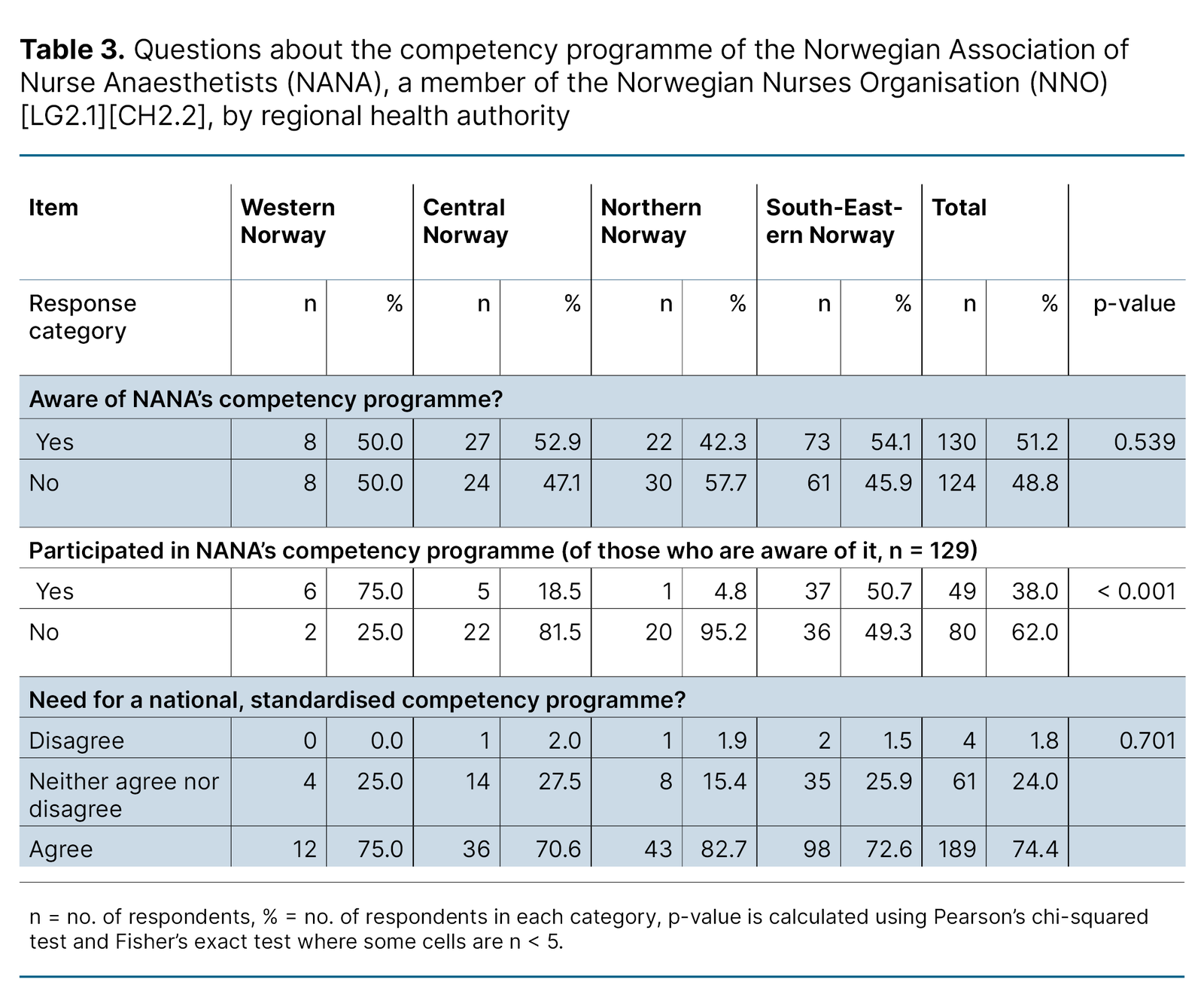
A majority of participants (74.4%; n = 189) agreed that there is a need for a national standardised programme for nurse anaesthetists to maintain and develop their competence. A total of 51.2% (n = 130) reported that they had heard of NANA’s competency programme. Of these, only 38.0% (n = 49) had participated in the programme (Table 3).
Discussion
The study found that more than half (59.1%) of nurse anaesthetists did not feel that sufficient time was allocated for competence development. Fifty per cent had not participated in an external course, up to 18% had not taken part in simulation training, and the time and resources allocated to learning activities varied between the regional health authorities. The learning activities in which nurse anaesthetists most frequently participated were internal courses, simulation training, professional development seminars, e-learning and internal teaching sessions.
Simulation training was rated as the most useful activity, with 75.2% reporting that it was very useful in terms of enhancing their competence. Almost all nurse anaesthetists (98%) reported that learning activities helped improve their clinical confidence, regardless of years of experience. A majority of respondents (74.4%) expressed a desire for a national, standardised competency programme, but only 38.0% of those who were aware of NANA’s competency programme reported participating in it.
Participation in learning activities and perceived usefulness
The findings of the study show that nurse anaesthetists most frequently participated in internal courses, simulation training, professional development seminars, e-learning and internal teaching sessions for competence development. They identified simulation training as the most useful activity. The ‘train as you fight’ concept (10) and the need for ‘learning by doing’ (9) help explain why simulation training is preferred in a practical specialty such as anaesthesia, and why this method is supported by the Norwegian Standard for Anaesthesia (5).
This finding is also consistent with the Safety-I principle, where as few things as possible should go wrong, and Safety II, which relates to the need to be proactive and to continuously anticipate a range of outcomes and events so that as many things as possible go right when unexpected situations occur (24). A meta-analysis highlights that simulation training is particularly important for critical situations, such as difficult airway management (8).
Practical learning activities are considered particularly important for situational learning in areas infrequently encountered by nurse anaesthetists, such as difficult airway management and malignant hyperthermia (7, 9, 10, 25). Our study did not examine which scenarios nurse anaesthetists consider most important to simulate. However, from a patient safety perspective, it is concerning that as many as 18.5% of respondents had not participated in any simulation training in the past year.
E-learning scored lowest in perceived usefulness among nurse anaesthetists, despite a high level of participation. Southwick et al. propose screen-based simulation as a hybrid solution, particularly to support learning in low-frequency but high-risk events that are rare in clinical practice (25).
The use of screen-based simulation training could also address some of the challenges of e-learning by making learning activities more practical and engaging (26–28). Other methods, such as internal courses and professional development seminars, were considered useful by more than 70% of respondents; however, many nurses did not have access to these (6.3 to 19% for internal courses and 10.4 to 32.7% for professional development seminars).
Averlid (18) notes that production pressures often overshadow professional development, which may explain why e-learning is widely used despite low perceived usefulness, while simulation training, internal courses and professional development seminars – which require more time and resources – are not sufficiently widespread, despite their potential value.
Although the majority of the sample consisted of experienced nurse anaesthetists, the participants represented a wide range of years of experience, and all reported increased clinical confidence as a result of maintaining and developing competence. This is consistent with findings from Green et al. (8), who showed that continuous training improves the ability to manage critical situations, which is essential in a field with narrow margins for error.
This universal sense of clinical confidence can be linked to nurse anaesthetists’ need to master complex tasks under pressure, such as airway management or emergency procedures. Bessmann et al. (7) argue that regularly updating competence reduces uncertainty and increases preparedness, particularly in relation to rare events.
Time, resources and systematic structuring of competence development
More than half of the respondents in our study felt that competence development was random. Other studies have demonstrated that competence development should be part of a systematically structured programme in order to maintain safety and quality standards in clinical practice (7, 27).
Competence development should be prioritised and systematically structured at managerial level to maximise outcomes (11, 26, 28). Norway’s National Health and Coordination Plan 2024–2027 also promotes a culture in which lifelong learning is considered essential for recruitment, qualifying and competence development (12).
Healthcare managers are required to maintain an overview of employees’ competence and training needs under the regulation on management and quality improvement in the health and care services (13). Our findings of insufficient time allocation and variable access to competence development measures can therefore be interpreted as reflecting a gap between national policy and clinical practice in the specialist health service. They also suggest continued variation between regional health authorities’ allocation of resources in competence development 13 years after the last consultancy report on the specialist health service by McKinsey (16).
The majority of respondents in our study reported that employees and management share responsibility for maintaining and developing competence. This suggests that most nurse anaesthetists are aware of their own responsibility to deliver competent and safe anaesthesia care in accordance with guidelines and requirements. However, providing effective, structured competence plans and allocating sufficient time require commitment from management at departmental and organisation level (29).
Organisations with well-integrated competence plans and structured allocation of resources achieve better learning outcomes and higher levels of clinical confidence among staff (27). This is important in order to remain an attractive employer for healthcare personnel throughout their career (30).
Need for national standards and better competency programmes
The study shows that 98.4% of participants identified a need for a national competency programme. Half of the respondents were not aware of NANA’s competency programme. Of the 51.2% who were aware of the programme, only 37.7% reported participating in it. This may be due to limited adaptation to local contexts or insufficient support for implementation.
National guidelines for cardiopulmonary resuscitation (CPR) from the Norwegian Resuscitation Council (NRC) have long emphasised the need for a national standard for CPR competence, training, retraining and documentation (31). The absence of national standards may result in inconsistent competence development and variation in the quality of healthcare services (16).
Experiences from the US Continued Professional Certification (CPC) programme suggest that standardisation can improve clinical confidence, but can be perceived as too rigid at a local level (32). Time constraints and resource limitations (18) can also contribute to low awareness and limited participation in NANA’s competency programme. International examples, such as IFNA standards, demonstrate that it is possible to combine flexibility and standardisation (26).
A Norwegian programme should include simulation training, as well as protected time, dedicated personnel and earmarked funding for training and education (16, 33). It should also be adapted to local contexts (34) in order to meet local needs and strengthen patient safety.
Strengths and limitations of the study
The uneven geographical distribution of responses, with particularly few respondents from Western Norway, may have reduced the representativeness of the study. In addition, the majority of respondents had more than ten years of experience. Future studies should aim to recruit a greater proportion of younger nurse anaesthetists. Imbalances in regional and age distribution limit the generalisability of the findings, as potential differences between regions and age groups may not be fully captured.
Future studies should seek a more balanced sample by distributing the questionnaire directly to departments rather than through intermediaries. The cross-sectional design provided a snapshot of nurse anaesthetists’ experiences, but longitudinal studies would have better captured changes in competence development over time (21).
Following a pilot study, we refined the questionnaire, which was distributed via Nettskjema.no, to enhance validity, but only a small number of nurse anaesthetists were involved in the pilot. As the questionnaire and its items were self-developed, this may have reduced validity and contributed to unclear wording and potential subjective bias.
Due to the low number of responses, we called a randomly selected sample of departments with broad geographical representation. These departments reported that they had not received the questionnaire, possibly due to email issues. Such distribution problems may have reduced the response rate, highlighting the need for more robust, verifiable recruitment channels in future studies.
The predominantly ordinal structure of the questionnaire captured participants’ perceptions well, but the limited number of open-ended questions reduced the nuance of the findings. The SPSS analyses, using descriptive statistics and cross-tabulations, were effective in identifying patterns, and Fisher’s exact test was used to handle small cell counts (21). Nevertheless, additional questions on resource use or routines could have resulted in a more in-depth analysis and better demonstrated the variation between regional health authorities.
Conclusion
This study explores the experiences of nurse anaesthetists in Norway in relation to maintaining and developing competence, as well as the challenges and needs within this field. The findings show that the majority of nurse anaesthetists in Norway agree that insufficient time and resources are allocated to competence development, and more than 50% have no access to external courses.
Nurse anaesthetists participate in a wide range of learning activities to maintain and develop their competence. All respondents reported improved clinical confidence following participation in learning activities, regardless of years of experience, and simulation training was highlighted as particularly useful. South-Eastern Norway Regional Health Authority reported a higher proportion of participation in various competence-building activities.
Respondents in this region also more frequently reported that departments had protected time and more structured arrangements for maintaining and developing competence than the other regional health authorities.
We also found that awareness of and participation in NANA’s competency programme were highest for nurse anaesthetists in South-Eastern Norway Regional Health Authority. There was broad agreement in all regions on the need for a standardised competency programme.
Practical implications for future research
A national, standardised competency programme should be implemented in clinical practice. The main emphasis should be on simulation training and structural support from management to ensure effective competence development and improve patient safety.
Future research could examine the long-term effects of a standardised competency programme on nurse anaesthetists’ clinical confidence and patient safety in a longitudinal study.
Marthe Skarpås and Ida Marie Baardsen share first authorship.
The authors declare no conflicts of interest.
Open access CC BY 4.0
The Study's Contribution of New Knowledge


Comments